

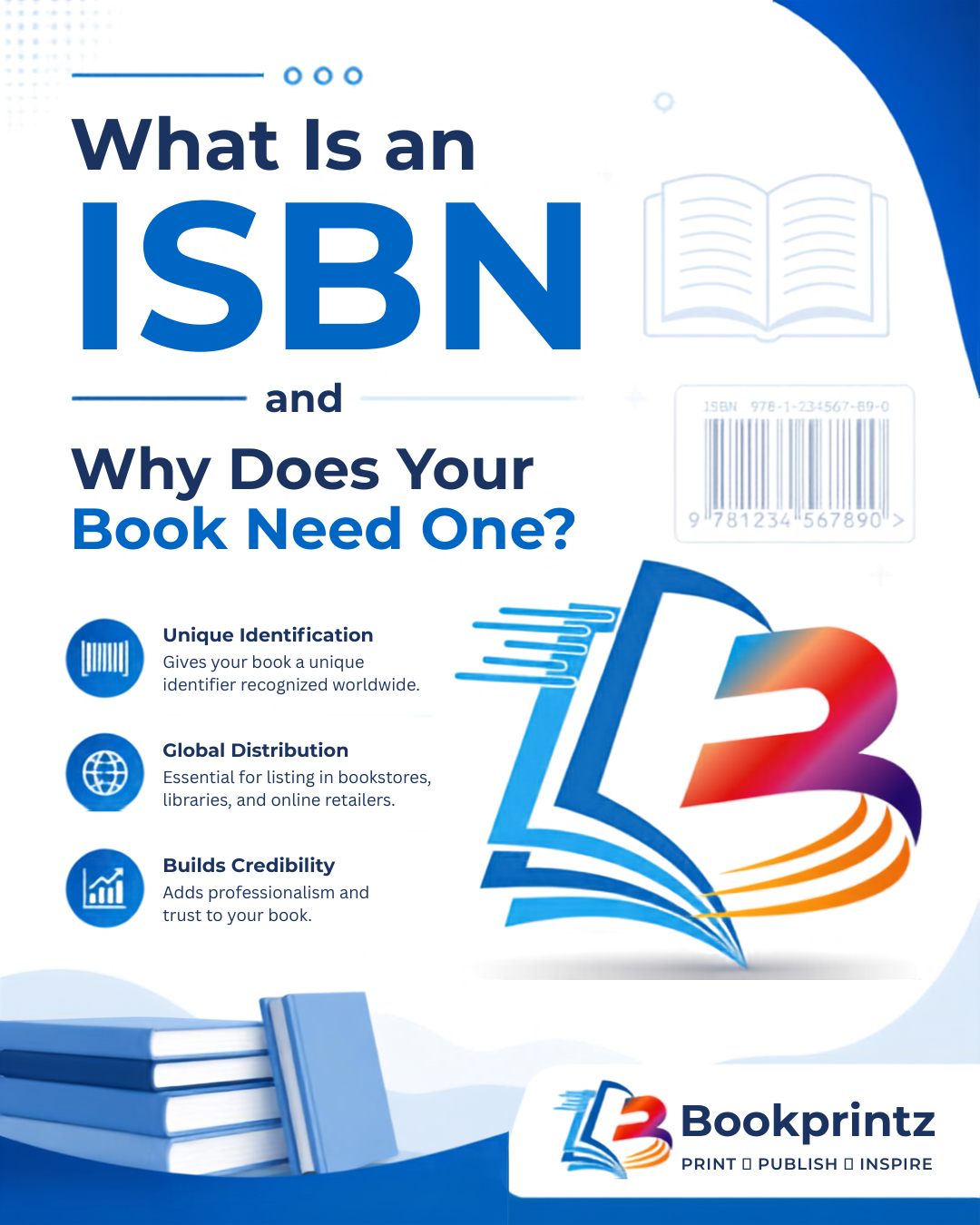
What Is an ISBN and Why Does Your Book Need One?
What is an ISBN? If you are planning to publish a book, this is an important question to understand. An ISBN gives a publication a unique identity and helps booksellers, libraries, distributors, and publishing platforms identify the correct book, edition, and format.
For authors and self-publishers, understanding this identification system is an important part of preparing a book for professional publication and distribution.
If you are preparing your manuscript for publication, explore our complete guide to turning your manuscript into a published book.
What Is an ISBN?
ISBN stands for International Standard Book Number. It is a unique 13-digit identifier assigned to a specific edition and format of a book.
Think of it as an identification number for your publication. It allows publishers, bookstores, libraries, distributors, and other organisations to distinguish one book from another.
For example, paperback and hardcover versions of the same title generally have different identification numbers because they are different publication formats.
Why Does Your Book Need an ISBN?
A standard book number gives your publication an identifiable place within the book-trade system. It makes the title easier to catalogue, order, distribute, list, and manage.
For authors who want their books to reach professional publishing and distribution channels, this identifier is particularly useful.
1. Gives Your Book a Unique Identity
Every book needs to be distinguishable from other publications. A unique identifier helps booksellers, libraries, publishers, and distributors find the correct title and edition.
This is especially important when different books have similar titles or when the same book is available in several formats.
2. Helps with Book Distribution
Bookstores, wholesalers, distributors, and libraries rely on standard identification information to organise and manage publications.
Having a recognised book identifier can therefore make the distribution process more efficient and help ensure that the correct edition reaches the intended market.
3. Supports Online Book Listings
Online bookselling and distribution platforms need accurate information about each publication.
A book number can help associate the correct title, author, publisher, edition, and format with a listing. This reduces confusion and makes book information easier to manage across different channels.
4. Makes Library Cataloguing Easier
Libraries and bibliographic databases use standard book information to identify and catalogue publications efficiently.
This is particularly valuable for academic books, textbooks, educational publications, research-based works, and reference books that may need to be discovered through library systems.
5. Identifies Different Editions and Formats
Different formats or substantially revised editions of a publication may require separate identifiers.
For example:
- Paperback – one number
- Hardcover – another number
- Certain digital editions – may require a separate number
Using separate identifiers helps prevent confusion between different versions of the same title.
6. Supports Professional Publishing
An ISBN does not indicate the quality of a book or guarantee its success. Instead, it places the publication within an internationally recognised identification system.
For authors and publishers seeking professional cataloguing and wider distribution, this can be an important part of the publishing process.
Does Every Book Need an ISBN?
Not every type of publication requires one. However, if you want your book to be professionally published, distributed, catalogued, or made available through conventional book-trade channels, obtaining one is generally advisable.
Certain private publications, promotional materials, journals, and other types of content may use different identification systems or may not require a book number.
Is an ISBN the Same as Copyright?
No. They serve different purposes.
A book number is primarily used for publication identification and book-trade management.
Copyright, on the other hand, protects an author’s original creative work and associated legal rights. Receiving a publication identifier does not itself establish or prove copyright ownership.
Why Is an ISBN Important for Authors?
For authors preparing to enter the publishing market, having a properly identified book can simplify several stages of publication and distribution.
It can help with cataloguing, bookseller records, library databases, distribution systems, and management of different editions. This makes it easier for publishing professionals and readers to identify the correct version of your work.
Final Thoughts
Understanding what is an ISBN and how it works is useful for anyone planning to publish professionally. Although it may appear to be just a number, it plays an important role in identifying books and distinguishing between different editions and formats.
For authors who want their publications to reach bookstores, libraries, distributors, and professional book-trade channels, obtaining the appropriate identifier is an important part of preparing a book for the wider market.
Your manuscript becomes a book. A unique identifier helps give that book its place in the publishing world.
For a quick visual guide, watch our book publishing video on Instagram

One response to “𝐖𝐡𝐚𝐭 𝐈𝐬 𝐚𝐧 𝐈𝐒𝐁𝐍 𝐚𝐧𝐝 𝐖𝐡𝐲 𝐃𝐨𝐞𝐬 𝐘𝐨𝐮𝐫 𝐁𝐨𝐨𝐤 𝐍𝐞𝐞𝐝 𝐎𝐧𝐞?”
[…] ISBN (International Standard Book Number) uniquely identifies a book and its […]