How Many Copies Should You Print for Your First Book?
Publishing your first book is exciting. After completing the writing, editing, cover design, and formatting, one important question comes next:
How many copies should you print?
Choosing the right number of copies for your first book is an important decision for every new author. Your ideal print quantity depends on your budget, expected demand, sales plan, and distribution needs.
Should you start with 25 copies? 50 copies? 100 copies? Or should you print hundreds of copies at once to reduce the cost per book?
For a first-time author, there is no single number that works for everyone. The right print quantity depends on your audience, budget, purpose, and how you plan to sell or distribute your book.
Why Your First Print Quantity Matters
Printing more copies usually reduces the cost per copy. However, ordering a large quantity also requires a higher initial investment.
If the books do not sell as quickly as expected, you may end up storing cartons of unsold copies. On the other hand, printing too few copies can mean placing another order sooner than expected.
The goal is therefore not simply to get the lowest printing price. It is to choose a quantity that balances cost, demand, storage, and risk.
Start by Understanding the Purpose of Your Book
Before deciding the quantity, ask yourself why you are printing the book.
If you are printing copies mainly for family, friends, colleagues, or personal distribution, a small quantity may be enough.
If you are planning a book launch, selling through your own network, attending events, or supplying copies to institutions, you may need a larger quantity.
Authors who already have an established audience may also be more comfortable starting with a higher print run.
If you plan to sell or distribute your book commercially, you may also need to consider obtaining an ISBN for your book.
Is 25–50 Copies a Good Starting Point?
For many first-time authors, 25 to 50 copies can be a practical trial quantity.
A small print run gives you an opportunity to see the final printed book, collect reader feedback, understand actual demand, and test your selling strategy without investing heavily in inventory.
This approach can be particularly useful for:
- First-time authors
- Poetry and short-story books
- Academic and reference books with a specialized audience
- Books intended for limited distribution
- Authors testing demand before a larger print run
Once these copies are distributed or sold, you can reorder based on actual demand.
When Should You Consider 100 Copies?
Printing around 100 copies may make sense when you already have a reasonable idea of your audience.
For example, you may have advance enquiries from readers, students, colleagues, institutions, or members of a professional network.
A 100-copy print run can also be suitable when you are planning a launch event or promotional campaign and expect to distribute a significant number of copies.
Depending on the printing specifications, increasing the quantity can also bring down the cost per copy.
What About 500 or 1,000 Copies?
Larger print runs can offer attractive unit costs, particularly with offset printing. But a lower unit price does not automatically mean it is the right choice for a first book.
Suppose you print 1,000 copies because the price per copy is low, but only 150 copies sell during the first year. You still need to manage the cost and storage of the remaining books.
Large quantities are generally more suitable when there is clear and predictable demand, such as institutional orders, confirmed distribution arrangements, bulk purchases, or an established readership.
Digital Printing Makes Small Print Runs Easier
In the past, authors often had to print large quantities to make book production economical.
Digital book printing has changed this.
Today, authors can produce smaller quantities professionally without committing to hundreds or thousands of copies at the beginning.
This makes short-run printing especially useful for independent and first-time authors.
You can print what you currently need and reorder when your stock becomes low.
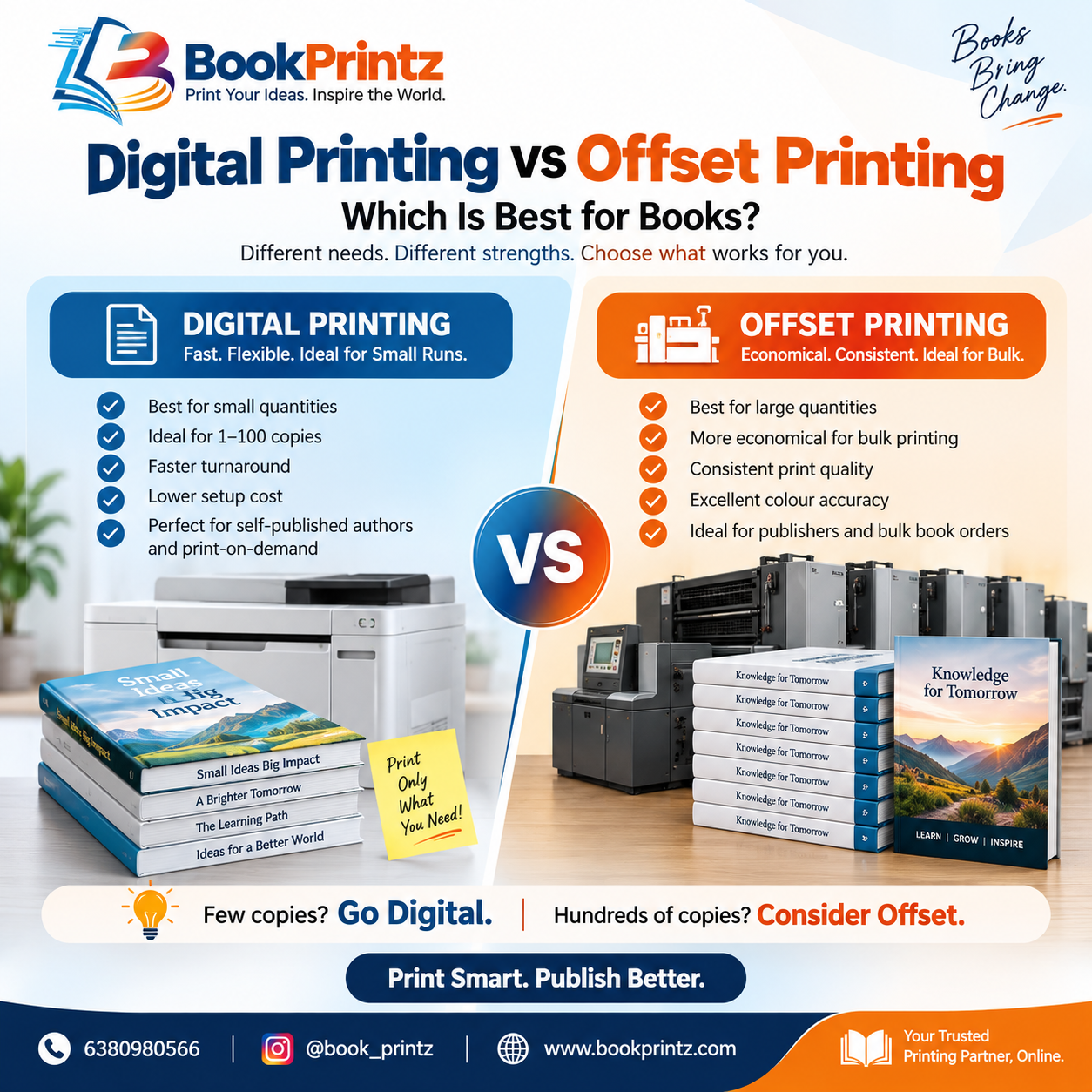
Short-Run Printing vs Bulk Printing
Both approaches have advantages.
Short-run printing offers lower initial investment, less inventory, easier storage, and greater flexibility. It is useful when demand is uncertain.
Bulk printing can reduce the cost per copy and is useful when you have confirmed demand for a larger number of books.
The better option depends on your individual publishing plan rather than simply choosing the lowest unit price.
Questions to Ask Before Deciding the Quantity
Before placing your first printing order, consider these questions:
- How many people are likely to buy my book immediately?
- Do I already have advance orders?
- Will I sell the book online, offline, or both?
- Do I need complimentary copies for reviewers, friends, institutions, or promotion?
- Am I organizing a book launch?
- How much can I comfortably invest in the first print run?
- Do I have space to store unsold books?
- How easily can I reorder additional copies?
Your answers will give you a much clearer idea of the quantity you actually need.
A Simple First-Time Author Strategy
Instead of asking, “What is the cheapest quantity to print?”, ask:
“How many copies can I realistically distribute or sell?”
For many first-time authors without confirmed bulk demand, starting with a smaller quantity can reduce financial risk.
For example, you could begin with 25, 50, or 100 copies, depending on your expected demand. Monitor how quickly they move and then plan your next print run.
If demand increases, you can print additional copies.
This approach gives you flexibility while helping you understand your real market.
Don’t Forget Complimentary Copies
When calculating your quantity, remember that not every printed copy will necessarily be sold.
You may want copies for:
- The author
- Contributors
- Reviewers
- Friends and family
- Libraries
- Institutions
- Promotional activities
- Book launch events
- Sample copies
For example, if you expect to sell 50 copies but need another 15 copies for promotional and complimentary purposes, your actual requirement is at least 65 copies.
Planning this before printing can prevent an unexpected shortage.
Final Thoughts
There is no perfect print quantity for every first-time author.
If you already have confirmed buyers or institutional demand, a larger print run may make financial sense. If you are still building your readership, a smaller print run gives you more flexibility and reduces the risk of keeping unsold inventory.
Modern digital and short-run book printing means you don’t have to print hundreds of copies just because it is your first edition.
Start with what you can realistically sell. Learn from the response. Reprint when you need more.
At BookPrintz, we help authors choose suitable book printing options based on their book size, page count, paper, binding, colour requirements, and required quantity.
Whether you need a small batch for your first launch or a larger quantity for wider distribution, you can choose a printing plan that fits your publishing requirement and budget.
Ready to print your first book?
Share your book size, number of pages, binding type, colour requirements, and required quantity with BookPrintz to get started.