Book Printing Cost Per Copy in India: What Determines the Price?
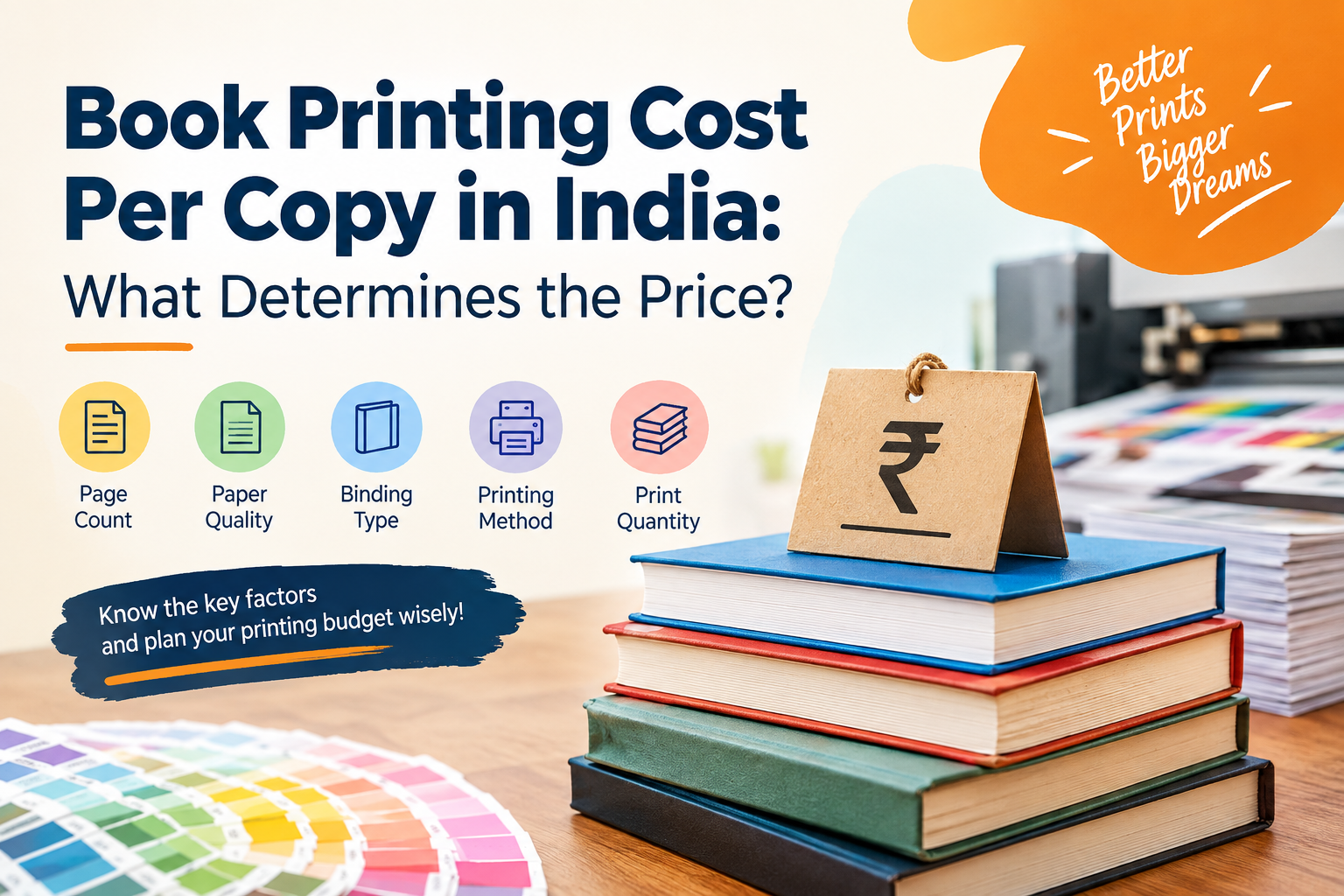
Book printing cost in India depends on several factors, including the number of pages, paper quality, binding type, printing method, and the total number of copies ordered. Understanding these factors can help authors and publishers estimate the cost per copy and choose the right printing option.
There is no single price that applies to every book. The printing cost per copy depends on several factors, including the size of the book, number of pages, paper quality, colour requirements, binding type and total quantity.
Understanding these factors helps you select the right printing options, control your budget and avoid unnecessary expenses. Let us look at the main elements that determine the book printing cost per copy in India.
1. Number of Pages
The total page count is one of the most important cost factors. A book with 300 pages naturally requires more paper, ink and production time than a 100-page book.
Before submitting your manuscript for printing, make sure that the content is properly formatted. Font size, line spacing, margins, paragraph spacing and blank pages can affect the final page count.
Professional typesetting can help reduce unnecessary pages without affecting readability.
2. Book Size
The dimensions of the book also influence the printing price. Common book sizes in India include:
- A4 – 210 × 297 mm
- A5 – 148 × 210 mm
- Demy – approximately 138 × 216 mm
- Crown – approximately 189 × 246 mm
- B5 – 176 × 250 mm
A5 and Demy sizes are widely used for novels, academic books, poetry collections and general nonfiction. Larger books require more paper and may cost more per copy.
Selecting a standard book size is usually more economical than choosing an unusual custom size.
3. Black-and-White or Colour Printing
The type of interior printing has a major impact on the total cost.
Black-and-white printing is suitable for novels, textbooks, research books, poetry collections and most academic publications. It is generally the most affordable option.
Colour printing is often required for children’s books, photography books, medical books, cookbooks, educational activity books and illustrated publications. Since colour printing uses multiple inks and requires greater production accuracy, it costs more than black-and-white printing.
If only a few pages require colour, ask the printer whether colour sections can be planned separately. This may help reduce the overall cost.
4. Paper Quality and GSM
Paper is another major component of book printing cost. GSM means grams per square metre and indicates the weight and thickness of the paper.
Common options include:
- 70 GSM or 80 GSM maplitho paper for textbooks and general books
- Cream or natural-shade paper for novels and reading books
- Higher-GSM paper for premium publications
- Art paper for photographs, illustrations and colour books
A higher GSM does not always mean that the paper is better for every book. The correct choice depends on the content, purpose, number of pages and expected reading experience.
For example, natural-shade paper can offer a comfortable reading experience for novels, while art paper is better suited to image-rich books.
5. Cover Type
The cover contributes to both the appearance and cost of the book. Most paperback books use a thick cover board with colour printing and lamination.
The cost may vary depending on:
- Cover board thickness
- Full-colour or single-colour printing
- Matte or gloss lamination
- Special textured or premium material
- Additional finishing effects
A well-designed cover improves the book’s professional appearance. However, expensive finishing options should be selected only when they support the book’s purpose and target market.
6. Binding Method
The binding method affects durability, appearance and price.
Perfect Binding
Perfect binding is commonly used for paperback books. The printed pages are attached to the cover using adhesive. It gives the book a clean and professional finish.
Centre-Pin Binding
Centre-pin binding is suitable for thin booklets, catalogues, magazines and publications with fewer pages. It is often economical for short documents.
Hardbound Binding
Hardbound books use a rigid cover and offer greater durability. They are suitable for premium books, commemorative volumes, institutional publications and special editions. Hardbound production generally costs more than paperback binding.
Spiral Binding
Spiral binding is useful for manuals, workbooks, training materials and books that need to remain open while being used.
The right binding method should be chosen according to the page count and purpose of the publication.
7. Printing Quantity
The number of copies ordered directly affects the cost per copy.
In traditional offset printing, producing a higher quantity generally reduces the cost per copy. However, printing hundreds of copies without confirmed demand can lead to storage problems and unsold stock.
Digital printing and print-on-demand services allow authors to print smaller quantities. You can print only the number of copies you currently need and order additional copies later.
For first-time authors, limited-demand books and frequently updated academic content, short-run or print-on-demand printing can be a practical option.
8. Digital Printing or Offset Printing
The printing technology used for the book also influences the price.
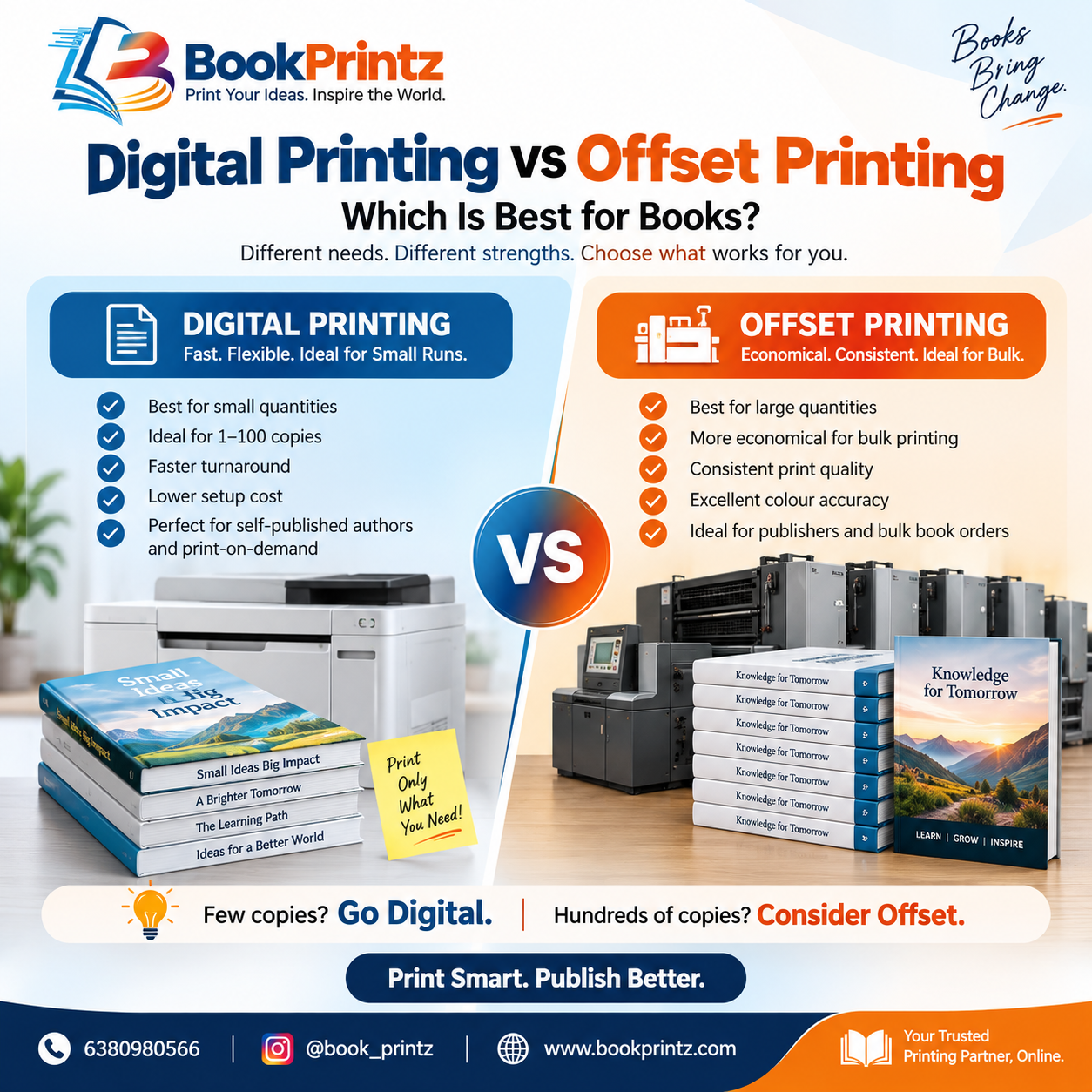
Digital printing is generally suitable for:
- Small quantities
- Sample copies
- Urgent printing
- Print-on-demand orders
- Frequently revised books
Offset printing is generally suitable for:
- Large print quantities
- Books with stable content
- Bulk distribution
- Publishers with predictable sales
Digital printing may have a higher unit cost for large quantities, while offset printing involves initial setup expenses but can become economical for bulk orders.
The best method depends on the required quantity, delivery schedule and available budget.
9. Cover Finishing and Special Effects
Additional finishing can improve the visual appeal of a book, but it also increases the production cost.
Optional features may include:
- Matte lamination
- Gloss lamination
- Spot UV
- Foil stamping
- Embossing
- Debossing
- Textured covers
- Flaps or jackets
For ordinary academic books and self-published titles, a professionally designed cover with standard lamination is often sufficient. Premium effects are more suitable for gift books, special editions and high-value publications.
10. Pre-Printing Services
Book production may involve more than printing and binding. Authors may also require:
- Manuscript formatting
- Typesetting
- Cover design
- Proofreading
- ISBN assistance
- Barcode generation
- File correction
- Print-ready PDF preparation
These services may be charged separately from the printing cost. When comparing quotations, check whether the price includes only printing or the complete book production service.
A very low quotation may not include design, formatting, corrections, taxes, packaging or delivery.
11. Packaging and Shipping
Delivery charges are normally calculated based on the number of books, total package weight and destination.
Books are heavy, particularly when printed using thicker paper. Therefore, shipping costs can become significant for bulk orders.
Before confirming the order, ask whether the quotation includes:
- Safe packaging
- Local delivery
- Courier charges
- Insurance for valuable shipments
- Delivery to multiple locations
Proper packaging is important because it protects the books from moisture, scratches, bent corners and transit damage.
How Can You Reduce Book Printing Costs?
You can reduce the cost without compromising essential quality by following a few practical steps:
- Select a standard book size.
- Finalise the manuscript before printing.
- Remove unnecessary blank pages.
- Use black-and-white printing where colour is not essential.
- Choose paper based on purpose rather than thickness alone.
- Select the right quantity according to actual demand.
- Use print-on-demand for uncertain or limited demand.
- Avoid unnecessary premium finishing.
- Request a sample copy before placing a large order.
- Obtain a detailed quotation that clearly lists all charges.
Information Required for an Accurate Printing Quote
To receive an accurate quotation, provide the printer with the following details:
- Final book size
- Total number of pages
- Black-and-white or colour interior
- Preferred paper type and GSM
- Paperback or hardbound cover
- Required number of copies
- Lamination or finishing preference
- Delivery location
- Print-ready file availability
- Any formatting or design support required
Providing complete specifications helps the printer calculate the cost correctly and reduces the possibility of unexpected charges later.
Is Print on Demand More Affordable?
Print on demand can be affordable when you need only a small number of books or do not want to invest in bulk inventory.
It allows authors to:
- Print according to demand
- Avoid storing unsold copies
- Reduce the initial investment
- Test the market with a small quantity
- Revise the content before reprinting
- Reorder books whenever required
The cost per copy may be higher than a large offset-printing order. However, the total financial risk can be much lower because you pay only for the copies you need.
Conclusion
The book printing cost per copy in India is determined by page count, book size, paper, colour usage, binding, quantity, finishing and delivery requirements. Therefore, comparing prices without comparing specifications may lead to an incorrect decision.
The cheapest option is not always the most suitable. Focus on print quality, binding strength, transparent pricing, professional support and reliable delivery.
At BookPrintz, we make book printing simple and accessible for authors, academicians, publishers and institutions. Whether you need a single copy, a short print run or a larger quantity, you can select printing options that match your purpose and budget.
Get a customised book printing quotation from BookPrintz and print only what you need.
Frequently Asked Questions
What is the average cost of printing one book in India?
The cost varies according to the book’s page count, size, paper, printing type, binding and quantity. A detailed specification is required to calculate an accurate price.
Does the cost per copy decrease for bulk orders?
In many cases, the cost per copy decreases when the order quantity increases, particularly in offset printing. However, short-run digital printing may be better when demand is uncertain.
Which paper is best for book printing?
The best paper depends on the type of book. Maplitho paper is commonly used for academic and general books, natural-shade paper for novels, and art paper for colour or image-rich books.
Is colour book printing expensive?
Colour printing generally costs more than black-and-white printing because it uses multiple inks and requires more complex production processes.
Can I print only one copy of my book?
Yes. Digital printing and print-on-demand services make it possible to print a single copy or a small number of copies.
What details should I provide for a printing quotation?
Provide the book size, page count, interior colour, paper preference, binding type, quantity, finishing requirements and delivery location.