
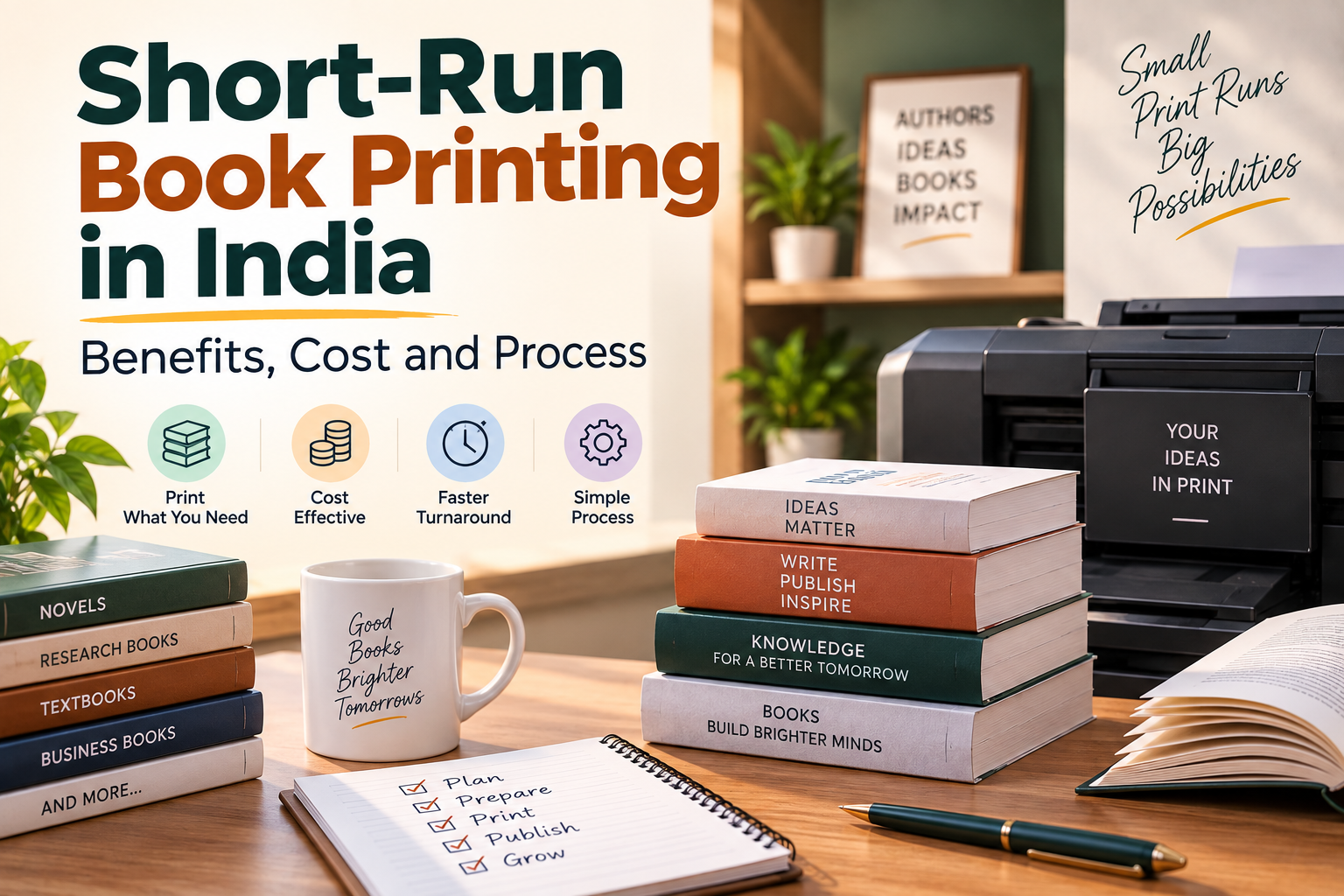
Short-Run Book Printing in India: Benefits, Cost and Process
Printing a book does not always mean ordering hundreds or thousands of copies. Today, authors, publishers, researchers, institutions, and businesses can print books in smaller quantities based on their actual needs.
This is known as short-run book printing.
Short-run book printing in India has become a practical option for people who need professional-quality books without investing in a large print quantity. Whether you are a first-time author, self-publisher, academic researcher, or organisation producing limited-edition material, short-run printing can help you control your budget and avoid unnecessary stock.
But how does it work, what are its benefits, and how much does it cost?
Let’s understand the complete process.
What Is Short-Run Book Printing?
Short-run book printing means printing a relatively small number of books in one production order.
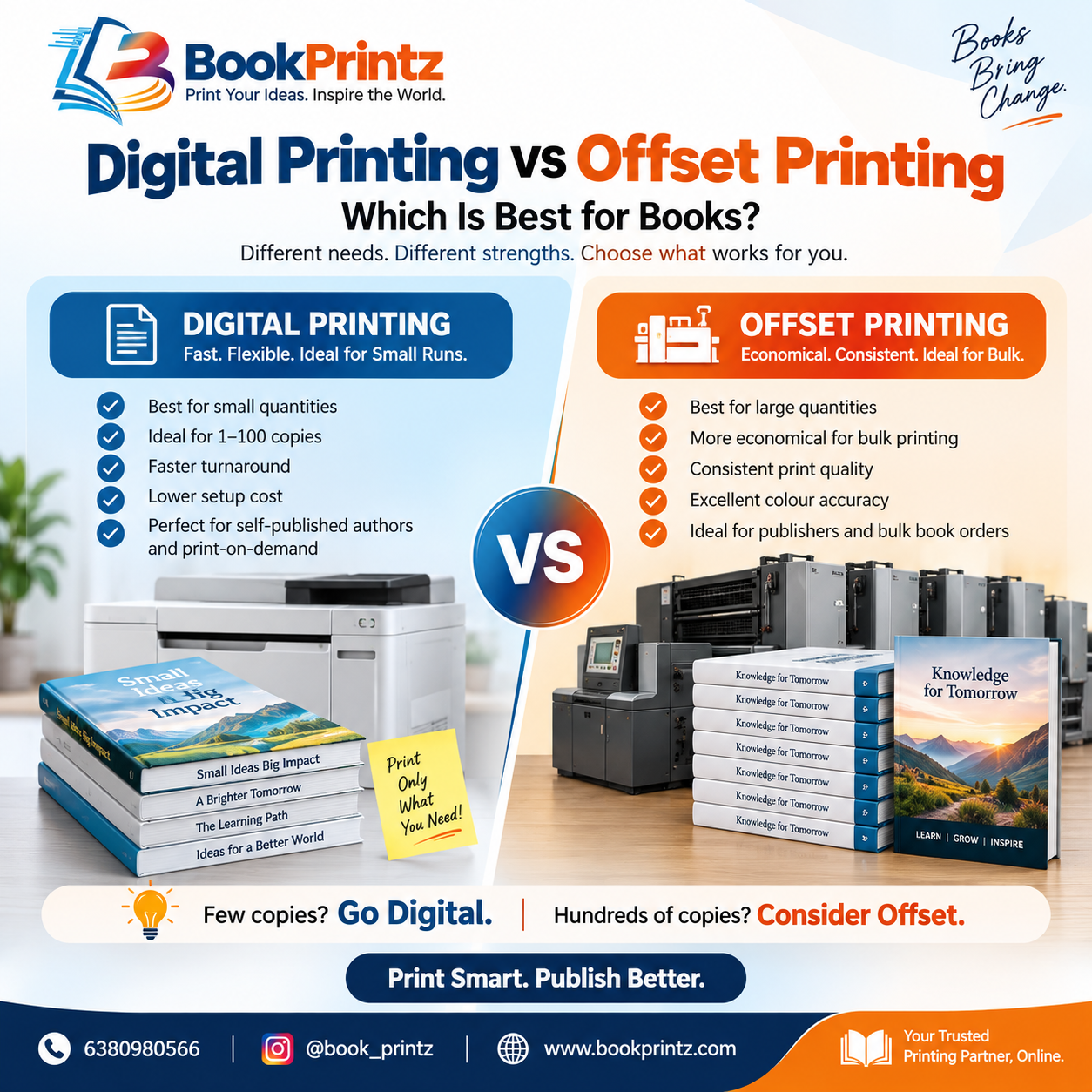
Unlike traditional offset printing, where larger quantities are generally preferred for better unit economics, short-run production commonly uses digital printing technology.
The exact quantity considered a “short run” can vary between printers. Depending on the book specifications and printing company, it could range from a handful of copies to a few hundred.
For example, an author may need:
- 10 copies for personal use
- 25 copies for a book launch
- 50 copies for initial sales
- 100 copies for an academic programme
- 200 copies to test market demand
Instead of ordering a large quantity, the author can print only what is currently required.
Who Can Use Short-Run Book Printing?
Short-run printing is suitable for many types of customers.
First-Time Authors
New authors may not know how many copies their first book will sell. Starting with a smaller print quantity reduces the financial risk.
Self-Published Authors
Self-published writers often manage their own printing and distribution. Short-run printing gives them greater control over inventory.
Researchers and Academicians
Research books, conference proceedings, edited volumes, monographs, and academic materials may have a specialised audience. Printing only the required quantity can be more practical.
Educational Institutions
Colleges, universities, training centres, and schools may require limited quantities of manuals, textbooks, proceedings, reports, or course materials.
Businesses and Organisations
Companies and organisations can use short-run printing for training manuals, annual publications, product guides, reports, and other limited-distribution materials.
Benefits of Short-Run Book Printing in India
1. Lower Initial Investment
One of the biggest advantages of short-run printing is that you don’t have to invest in hundreds of copies at once.
You can begin with a manageable quantity and print additional copies later.
For first-time authors, this makes book printing financially easier to manage.
2. Reduced Inventory Risk
Large print runs can leave authors with boxes of unsold books.
With short-run book printing, you can estimate your immediate requirement and print accordingly.
This reduces the risk of excess inventory and unnecessary spending.
3. Less Storage Space Required
Printed books require proper storage. Large quantities can occupy considerable space and may be exposed to dust, moisture, or physical damage if they are not stored correctly.
Smaller print quantities are much easier to manage.
4. Easy to Make Corrections
Suppose you print 1,000 copies and later discover an incorrect phone number, spelling error, or formatting issue. Correcting the remaining stock is difficult.
With short-run printing, corrections can be made to the digital file before the next batch is printed.
This is particularly useful for:
- First editions
- Academic books
- Training manuals
- Frequently updated materials
- Test publications
5. Good for Testing Market Demand
A first-time author may not know whether the initial demand will be 50 copies or 500 copies.
Short-run printing allows you to start small.
If readers respond positively and demand increases, you can order another batch or consider bulk printing.
6. Faster Production for Suitable Projects
Digital printing generally requires less production setup than traditional offset printing.
For suitable books, this can make short-run production relatively quick and convenient, although actual turnaround time depends on page count, quantity, binding, finishing, and the printer’s workload.
What Is the Cost of Short-Run Book Printing in India?
There is no single fixed price for short-run book printing.
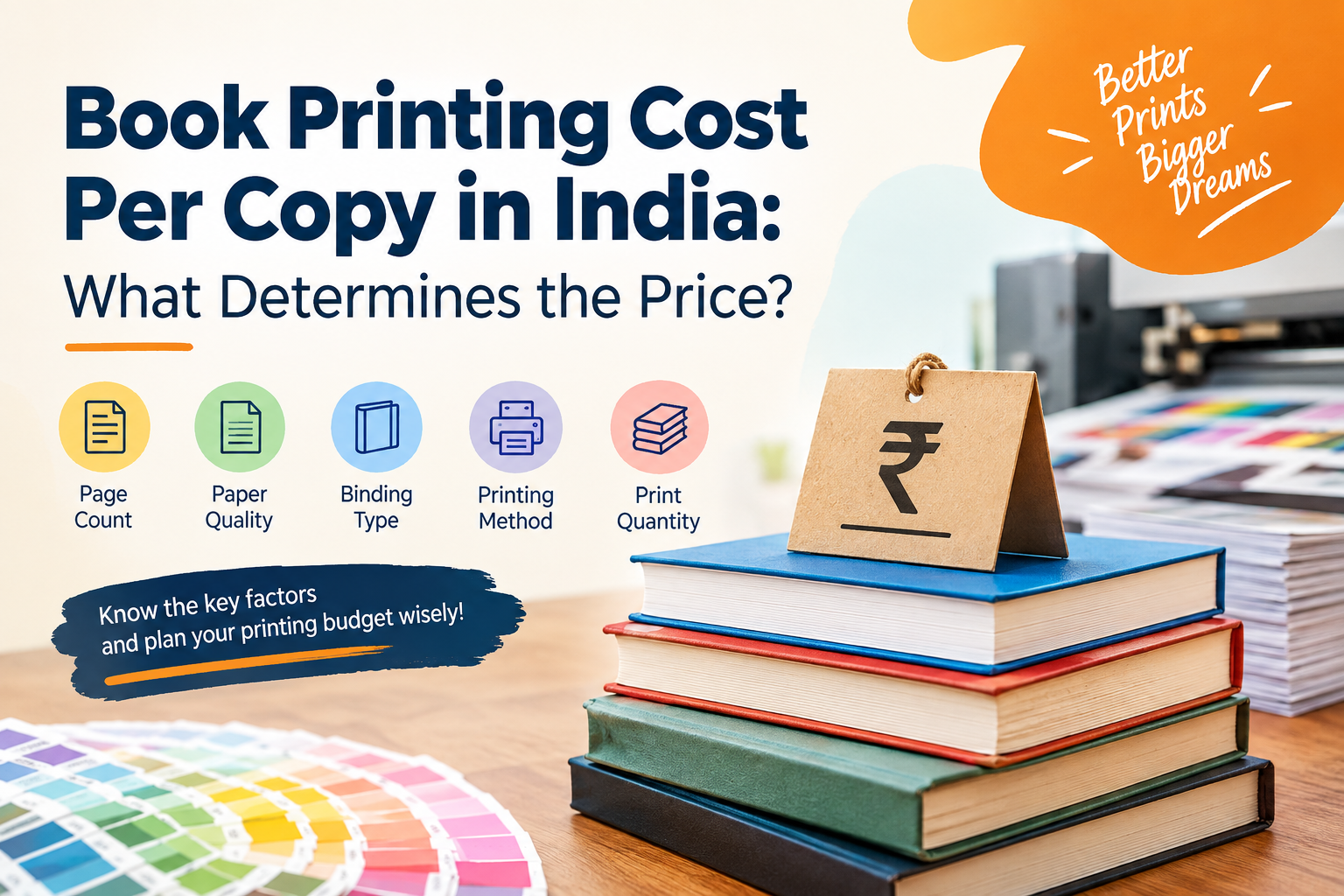
The final printing cost depends on the specifications of your book.
Some of the most important factors are:
Number of Pages
A 100-page book will normally cost less to print than a 400-page book with similar specifications.
Book Size
Common sizes such as A4, A5, B5, and other standard book dimensions can affect paper usage and production costs.
Printing Type
You can choose between:
Black & White Printing: Commonly used for novels, academic books, textbooks, and research publications.
Colour Printing: Suitable for children’s books, photography books, educational materials, catalogues, and books containing colour illustrations.
Colour pages generally cost more than black-and-white pages.
Paper Quality
Paper type and GSM also affect the cost.
Authors should choose paper based on the purpose of the book rather than assuming that heavier paper is always better.
Binding
The binding method is another important factor.
Common options include:
- Paperback / perfect binding
- Hardbound books
- Spiral binding
- Centre pinning or saddle stitching for suitable publications
The best option depends on the number of pages, book type, budget, and intended use.
Cover and Finishing
Your cover specifications can also influence the final cost.
Options may include:
- Colour cover printing
- Matte lamination
- Gloss lamination
- Special finishes
- Hard case binding
Number of Copies
Quantity plays an important role in determining the cost per book.
Printing 100 copies may result in a different unit cost than printing 10 copies because some production costs are distributed across the total quantity.
Therefore, when requesting a printing quotation, provide complete book specifications rather than asking only, “What is the price per book?”
Information Needed to Get a Book Printing Quote
Before contacting a book printer, keep these details ready:
- Book size
- Total number of pages
- Black-and-white or colour interior
- Paper type and GSM
- Binding type
- Cover specifications
- Required number of copies
- Delivery location
- Any special finishing requirements
Providing complete details helps the printing company calculate a more accurate quotation.
Short-Run Book Printing Process
The exact workflow may vary between printing companies, but a typical process includes the following stages.
Step 1: Prepare Your Manuscript
Complete your book manuscript and perform the necessary editing and proofreading.
The content should ideally be finalised before printing begins.
Step 2: Format the Interior Pages
The manuscript must be formatted according to the selected book size.
Formatting may include:
- Margins
- Fonts
- Line spacing
- Page numbering
- Headers and footers
- Chapter headings
- Images and tables
Proper formatting ensures that the printed book looks professional.
Step 3: Design the Book Cover
A complete book cover generally needs to account for the front cover, back cover, and spine where applicable.
The spine width depends on factors such as the number of pages and paper thickness, so the final cover should be prepared using the printer’s production specifications.
Step 4: Prepare Print-Ready Files
The interior and cover files should be prepared in the format required by the printer, commonly print-ready PDF files.
Images should have sufficient quality, fonts should display correctly, and the required bleed and margins should be checked.
Step 5: Review a Sample or Proof
Where available, reviewing a proof copy can help identify errors before the complete order is produced.
Check:
- Page sequence
- Text alignment
- Image quality
- Cover positioning
- Colours
- Binding
- Margins
- Missing pages
- Typographical errors
Approving a proof carefully can prevent costly mistakes.
Step 6: Print and Bind the Books
Once the files are approved, the required quantity is printed.
The printed sheets are then finished and bound according to the selected specifications.
Step 7: Quality Check and Delivery
The completed books should undergo basic quality checks before packing and dispatch.
Delivery time and charges can vary depending on quantity, destination, and shipping method.
Short-Run Printing vs Bulk Printing
Choosing between short-run and bulk printing depends mainly on your requirements.
| Feature | Short-Run Printing | Bulk Printing |
|---|---|---|
| Quantity | Smaller | Larger |
| Initial investment | Lower | Higher |
| Storage requirement | Lower | Higher |
| Inventory risk | Lower | Higher |
| Cost per copy | Often higher | Can be lower at volume |
| Updating content | Easier between batches | Difficult after stock is produced |
| Best for | Limited or uncertain demand | Established/high-volume demand |
Neither method is automatically better.
If you know that you need a large number of copies, bulk printing may provide better unit economics. If demand is uncertain, short-run printing offers greater flexibility.
Short-Run Printing vs Print on Demand
Short-run printing and Print on Demand (POD) are closely related, but they are not always identical.
In short-run printing, you usually order a small batch, such as 25, 50, or 100 books.
With true print-on-demand workflows, copies can be produced in response to orders or requirements, potentially in very small quantities.
Both approaches aim to reduce unnecessary inventory, but the production and distribution models can differ.
Is Short-Run Book Printing Right for You?
Short-run book printing may be suitable if you:
- Are publishing your first book
- Need only a limited number of copies
- Have a niche readership
- Want books for an event or book launch
- Have a limited initial budget
- Want to test market demand
- Need academic or institutional books
- Expect future content updates
- Do not have space for large inventory
However, if you already have confirmed orders for a large quantity, compare short-run digital printing with bulk or offset printing before making your final decision.
Tips to Reduce Your Book Printing Cost
You don’t always have to compromise on quality to control printing costs.
Start by selecting a practical book size and paper suitable for the content. Use colour pages only when they add real value. Finalise proofreading before production to avoid reprinting corrected copies.
Most importantly, request quotations using the same specifications when comparing printing companies. A cheaper quote may simply be based on different paper, binding, finishing, or production standards.
Compare like with like.
Final Thoughts
Short-run book printing in India offers authors and publishers a flexible way to produce books without committing to a large initial quantity.
It is especially useful for first-time authors, self-publishers, academic writers, institutions, and anyone with limited or uncertain demand.
The final printing cost depends on your book size, number of pages, paper, colour requirements, binding, finishing, quantity, and delivery.
Before printing, finalise your manuscript, choose suitable specifications, obtain a detailed quotation, and review the print-ready files carefully.
Starting with the right quantity can help you manage costs today while leaving room to print more copies as your readership grows.
One response to “Short-Run Book Printing in India: Benefits, Cost and Process”
[…] authors who need only a limited number of copies, short-run book printing can also be a practical and cost-effective […]