
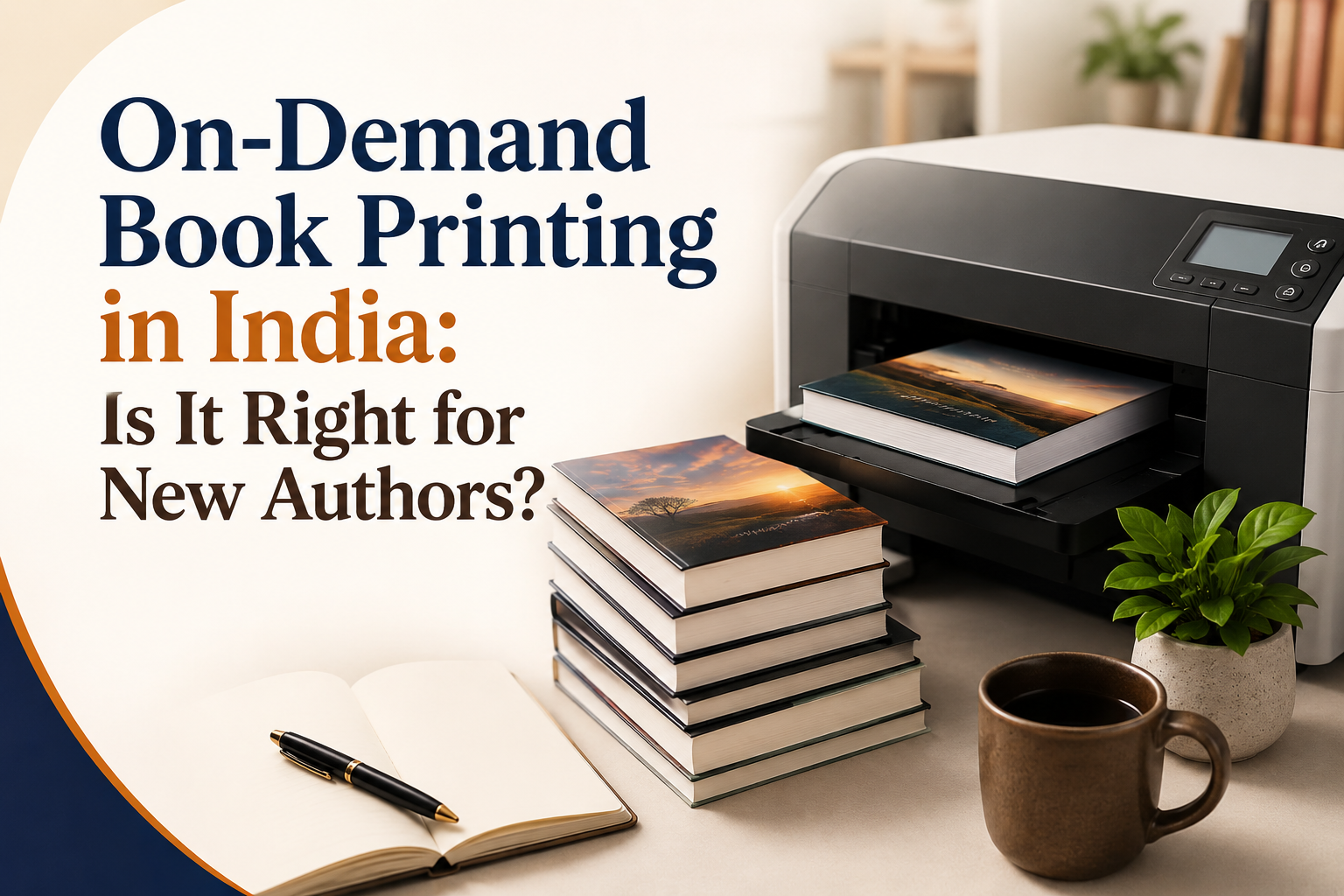
On-Demand Book Printing in India: Is It Right for New Authors?
Publishing a book is an exciting achievement for any writer. However, printing hundreds of copies can be expensive for first-time authors. On-demand book printing in India offers a flexible alternative, allowing authors to print books according to actual requirements without investing heavily in large quantities.
Printing hundreds of books at once can require a large investment. It also creates another problem—what happens if those copies do not sell?
This is where on-demand book printing in India can be a practical option. Instead of producing a large quantity in advance, books can be printed in small quantities or when they are required.
What Is On-Demand Book Printing?
On-demand book printing, commonly known as Print on Demand (POD), is a printing method where copies of a book are produced based on actual demand.
In traditional bulk printing, an author may order hundreds or thousands of copies at once. With on-demand printing, there is no need to maintain such a large inventory.
The official Indian ISBN guidance describes print-on-demand as a form of printing in which a publication is printed and bound in response to a specific customer order.
This makes POD particularly useful for self-published and first-time authors who are unsure about the initial demand for their books.
How Does Print on Demand Work?
The process is relatively simple.
First, the author prepares the final manuscript and book cover. The files must be properly formatted according to the selected book size and printing specifications.
Once the print-ready files are prepared, they are submitted to the printing or publishing service.
Copies can then be produced whenever they are needed. Depending on the publishing arrangement, books may also be supplied directly to readers after orders are received.
This eliminates the need to keep hundreds of printed copies in storage.
Why Is On-Demand Printing Useful for New Authors?
1. Lower Initial Investment
One of the biggest concerns for first-time authors is publishing cost.
Bulk printing requires authors or publishers to spend money on a larger quantity of books before knowing how many copies will actually sell.
On-demand printing allows authors to start with fewer copies, reducing the amount of money committed to printing at the beginning.
2. Less Risk of Unsold Books
Imagine printing 500 copies of your first book and selling only 100.
The remaining 400 copies require storage and represent money already spent.
With print-on-demand, production can follow actual demand. This significantly reduces the risk of having large quantities of unsold books.
3. No Large Storage Requirement
Books take up considerable space when printed in bulk.
Authors who manage their own publishing may not have access to a warehouse or dedicated storage facility. POD reduces this problem because copies can be produced as required.
4. Ideal for Testing the Market
A new author may not know how readers will respond to a book.
Instead of immediately committing to a large print run, authors can begin with on-demand or short-run printing and observe the response.
If demand grows significantly, they can later consider bulk printing.
5. Easier to Make Corrections
Finding a small typo after printing hundreds of copies can be frustrating.
With an on-demand workflow, corrections can generally be made to the source files before future copies are produced, subject to the requirements of the printing or distribution platform.
This flexibility is especially valuable for educational, academic and professional books that may require periodic updates.
Are There Any Disadvantages?
On-demand printing is convenient, but it is not suitable for every situation.
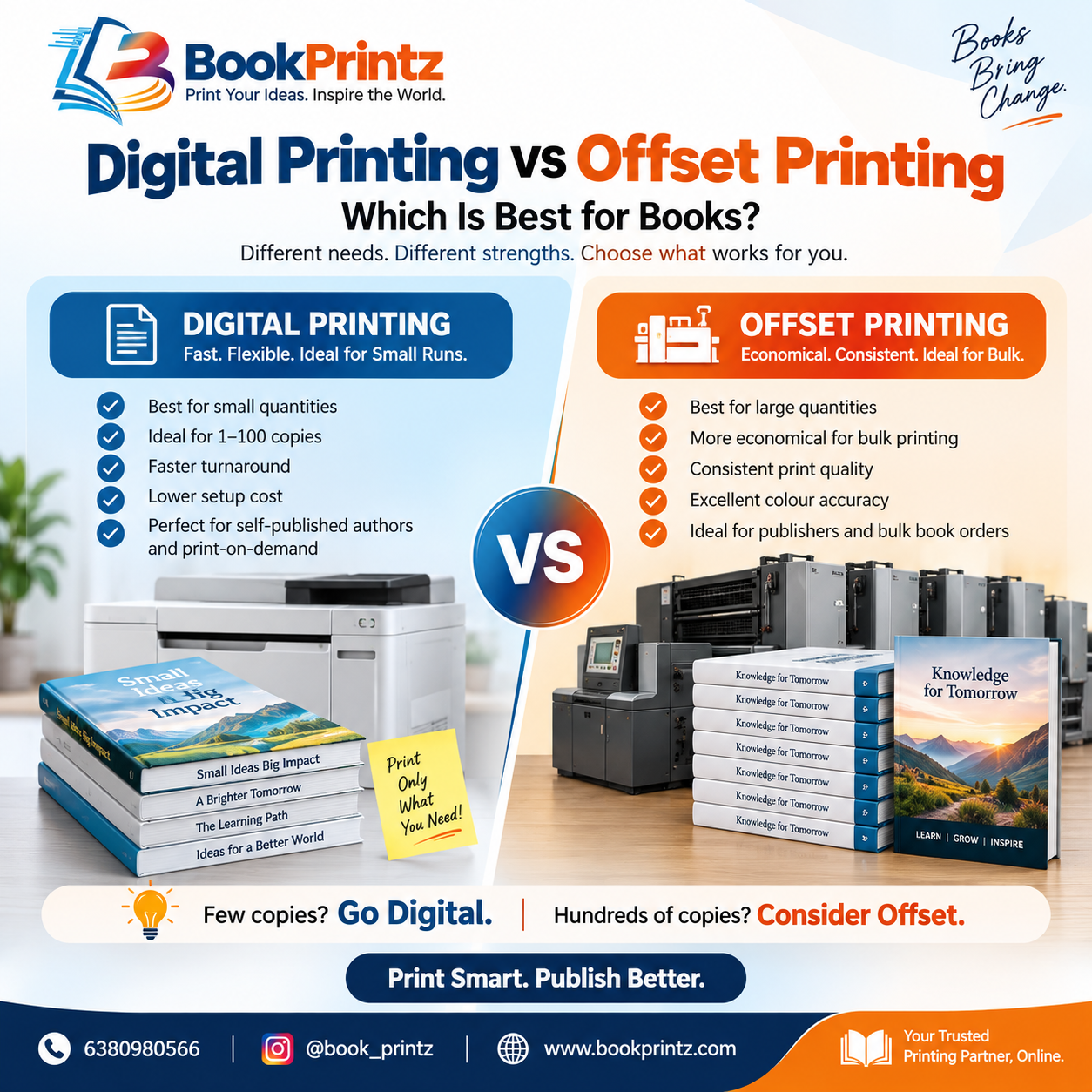
The cost per copy can be higher than large-volume offset printing. Bulk printing usually becomes more economical per book as the quantity increases.
Authors may also have fewer choices for special paper, binding, finishing or other premium production requirements depending on the POD provider.
Before choosing on-demand printing, new authors should also understand how to turn a manuscript into a published book, including book size, formatting, ISBN, cover design, and printing decisions.
On-Demand Printing vs Bulk Printing
| Factor | On-Demand Printing | Bulk Printing |
|---|---|---|
| Initial investment | Lower | Higher |
| Printing quantity | Small/as required | Large quantity |
| Storage requirement | Minimal | Storage may be required |
| Unsold stock risk | Lower | Higher |
| Cost per copy | Usually higher | Usually lower at volume |
| Best suited for | New authors and uncertain demand | Established demand and bulk requirements |
What About ISBN?
Print-on-demand books can have an ISBN just like conventionally printed books.
According to India’s official ISBN guidance, POD is considered a printing technology rather than a separate publication format by itself. However, if the product format changes—for example, from hardcover to paperback—a separate ISBN may be required.
Authors should therefore ensure that their ISBN and publication details correctly match the edition and format being published.
Is On-Demand Book Printing Right for You?
On-demand printing may be a good choice if:
- You are publishing your first book.
- You are unsure about expected sales.
- You want to avoid investing in hundreds of copies.
- You do not have space to store books.
- You want to test reader demand before bulk printing.
- Your book targets a niche or specialised audience.
Bulk printing may be a better choice when you already have confirmed orders, institutional requirements, event sales or predictable demand for a large number of copies.
A Hybrid Approach Can Also Work
Authors do not always have to choose only one method.
A practical approach is to use on-demand printing for regular requirements and bulk printing when there is confirmed demand for a larger quantity.
For example, an author may use a small print run for a book launch, conference or direct sales while keeping an on-demand option for future requirements.
This provides flexibility while helping control printing and inventory costs.
Final Thoughts
For many new authors, the biggest challenge is not simply getting a book printed. It is deciding how many copies to print without taking unnecessary financial risk.
On-demand book printing provides a flexible way to enter the publishing market without committing immediately to a large print run.
However, POD is not automatically the cheapest option for every author. If you expect substantial sales or already have confirmed bulk orders, traditional bulk printing may offer a better cost per copy.
The right choice depends on your budget, expected demand, book specifications, distribution plan and long-term publishing goals.
For first-time authors who want to start small and scale according to demand, on-demand book printing can be an effective way to begin their publishing journey.
2 responses to “On-Demand Book Printing in India: Is It Right for New Authors?”
[…] printing and Print on Demand (POD) are closely related, but they are not always […]
[…] The good news is that modern book printing allows authors to start small and print more copies whene… […]