How to Publish Your First Book: A Beginner’s Guide
Publishing your first book is an exciting achievement. You may be a researcher, professor, student, professional, or first-time author with an idea you want to share with the world. However, many new authors are unsure about where to begin and what happens during the publishing process.
The good news is that publishing a book becomes much easier when you understand the basic steps.
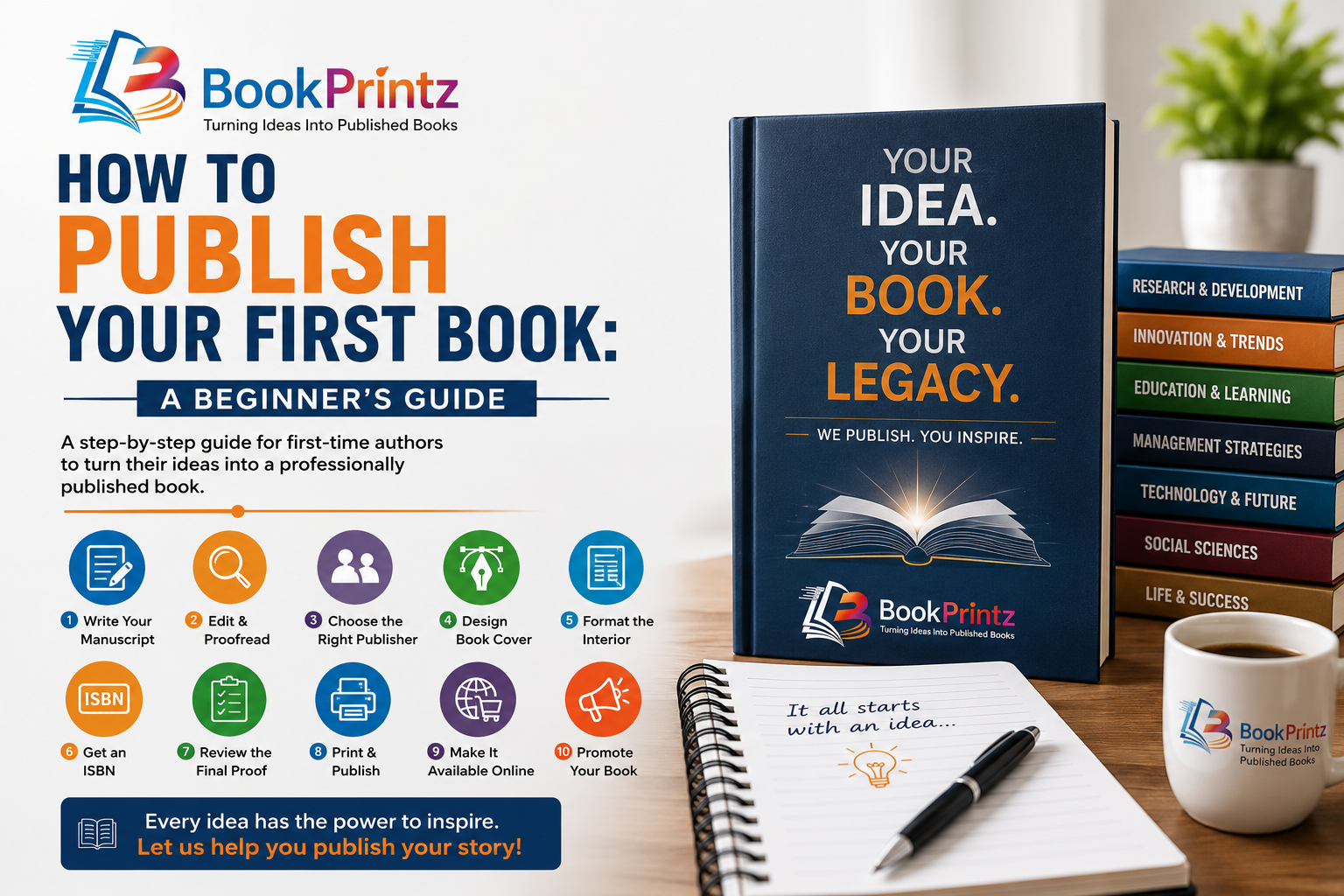
1. Complete Your Manuscript
The first step is to complete your manuscript. Before sending it for publication, read the entire content carefully. Make sure the chapters are arranged properly and the ideas are presented clearly.
Your manuscript should ideally include the title page, table of contents, chapters, references, and other necessary sections.
2. Edit and Proofread Your Content
Even a well-written manuscript can contain spelling, grammar, punctuation, or formatting errors. Editing and proofreading help improve the clarity and quality of your book.
A professionally edited manuscript also creates a better reading experience and improves the credibility of the author.
3. Choose the Right Publisher
Selecting a suitable publisher is an important decision. Before choosing one, understand the services they provide.
Check whether the publisher supports services such as editing, formatting, cover design, ISBN registration, printing, eBook creation, online distribution, and marketing.
4. Design an Attractive Book Cover
Your book cover creates the first impression. A professional cover should reflect the subject and purpose of your book while remaining attractive to your target readers.
The title, author name, images, colours, typography, and overall design should work together effectively.
5. Format the Interior of the Book
Book formatting is different from preparing an ordinary Word document. Proper margins, fonts, headings, page numbers, tables, images, and chapter arrangements make the book comfortable to read.
The formatting should also match the selected book size and printing requirements.
6. Obtain an ISBN
ISBN stands for International Standard Book Number. It is a unique identification number assigned to a book and helps identify its specific edition and format.
An ISBN is particularly important when you plan to distribute or sell your book through bookstores, libraries, and online platforms.
7. Review the Final Proof
Before printing or releasing your book, carefully check the final proof.
Look for spelling mistakes, incorrect page numbers, missing content, image quality problems, formatting errors, and incorrect author or publication information. Making corrections at this stage can prevent costly mistakes later.
8. Print and Publish Your Book
Once the final proof is approved, your book is ready for publication. Depending on your requirements, you can choose printed copies, an eBook, or both.
The number of printed copies can also be decided based on your expected readership, budget, and distribution plan.
9. Make Your Book Available Online
Publishing is only the beginning. Readers must be able to discover and purchase your book.
Online bookstores, publisher websites, social media, author profiles, academic networks, and other digital channels can help your book reach a wider audience.
10. Promote Your Book
Tell people about your book. Share its cover, description, key ideas, launch information, reviews, and purchase details through your professional and social networks.
Authors can also use LinkedIn, Facebook, Instagram, WhatsApp, email campaigns, seminars, conferences, and academic networks to create awareness.
Final Thoughts
Publishing your first book may initially seem complicated, but it becomes manageable when you follow the process step by step.
Start with a strong manuscript, give importance to editing and design, choose the right publishing support, review your final proof carefully, and develop a plan to reach your readers.
Every published book begins with an idea. The important step is turning that idea into a book that readers can hold, read, and remember.